
One connected pathway.
From screening to polysomnography.
RespiCare provides Löwenstein Medical sleep diagnostic solutions for home sleep screening, clinical polygraphy and comprehensive polysomnography—supported by a consistent software environment and specialist product support.

Technology matched to each level of clinical investigation.
Löwenstein Medical provides a scalable diagnostic portfolio—from straightforward home screening to advanced laboratory-based sleep studies. The devices are designed to support consistent processes, clear data acquisition and structured clinical evaluation.
Sleep Screening
Accessible overnight recording of key respiratory and oximetry parameters in the home environment.
Samoa liteCompact Polygraphy
Lightweight recording with intuitive operation and connectivity to compatible Löwenstein sleep therapy devices.
SamoaAdvanced Polygraphy
Expanded recording options for respiratory medicine, cardiology, ENT, neurology and specialist sleep services.
ScalaPolysomnography
A flexible 65-channel platform for detailed sleep-laboratory investigation and comprehensive physiological recording.
Sonata
Samoa lite
Sleep apnea screening made easy.
Samoa lite is a compact screening device designed to support the detection and monitoring of sleep-related breathing disorders. Overnight measurements can be performed in the patient’s home and reviewed later using the associated diagnostic software.
- Respiratory recording
- Body-position measurement
- SpO2 monitoring
- Pulse measurement
- Snoring detection
- Home-based overnight use
- Straightforward patient setup
- Software-based data evaluation

Samoa
Smart. Simple. Small.
Samoa combines compact dimensions, an integrated colour display and intuitive sensor connections in a lightweight polygraphy platform. It is designed for standardised diagnostic and therapy-monitoring workflows.
- Small and lightweight design
- Integrated colour display
- Intuitive sensor connections
- Thermistor measurement as a second flow channel
- Wireless data exchange with compatible therapy devices
- Suitable for diagnostic and therapy-monitoring workflows
- Patient-focused wearing comfort
- Designed for efficient routine use
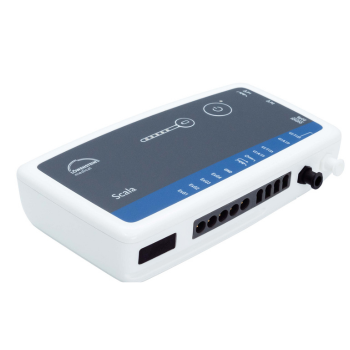
Scala
Versatile polygraphy for multidisciplinary services.
Scala is designed for the detection and assessment of sleep-related breathing disorders while providing additional recording options for specialist clinical applications. Its flexibility supports use across sleep medicine, respiratory medicine, cardiology, ENT and neurology.
- Differential-pressure flow measurement
- Optional thermistor flow recording
- Snore microphone capability
- Configurable electrophysiological inputs
- ECG, EMG or EEG signal options
- Respiratory effort using pressure or RIP technology
- Online and offline recording
- Optional WLAN data transmission
- Integration of external analogue signals
- Time-synchronised video and audio capability
Sonata
Modern. Versatile. Future-proof.
Sonata is Löwenstein Medical’s 65-channel polysomnography platform, developed for demanding sleep-laboratory applications where signal quality, flexibility and efficient clinical handling are essential.
One software environment for diagnostic review.
MiniScreen Viewer supports the review, evaluation and reporting of polygraphic and polysomnographic measurements within a structured clinical workflow.
Structured recording review
Review recorded signals and relevant overnight measurement periods in a consistent software environment.
Event analysis and validation
Support clinical evaluation of respiratory events, sleep data and recorded physiological signals.
Polygraphy and polysomnography
A common review environment across compatible Löwenstein Medical diagnostic platforms.
Clinical reporting support
Generate and configure reports to support local diagnostic review and documentation requirements.
Designed around real diagnostic pathways.
The portfolio can support screening and diagnostic services operating across community, hospital and specialist sleep-laboratory settings.
Home Sleep Testing
Portable overnight measurements outside the hospital environment where this is clinically appropriate.
Hospital Diagnostics
Flexible equipment for respiratory departments, sleep services and wider hospital-based diagnostic pathways.
Therapy Assessment
Recording and review of relevant respiratory signals during PAP or NIV therapy assessment.
Sleep Laboratory Studies
Detailed polysomnographic investigation with comprehensive signal acquisition and structured analysis.
Specialist support from product selection onward.
RespiCare works with healthcare services to identify an appropriate sleep diagnostic configuration based on the intended clinical pathway, required signals and operational environment.
A connected portfolio, not a collection of isolated devices.
Samoa lite, Samoa, Scala, Sonata and MiniScreen Viewer create a progressive diagnostic environment that can support services as requirements develop—from initial screening through to detailed polysomnography.
Planning or upgrading a sleep diagnostic service?
Speak with RespiCare about screening, polygraphy, polysomnography, software and the most appropriate Löwenstein Medical configuration for your clinical requirements.